

Challengers (2024)
“It’s about people wanting what other people don’t want to give" -Luca Guadagnino

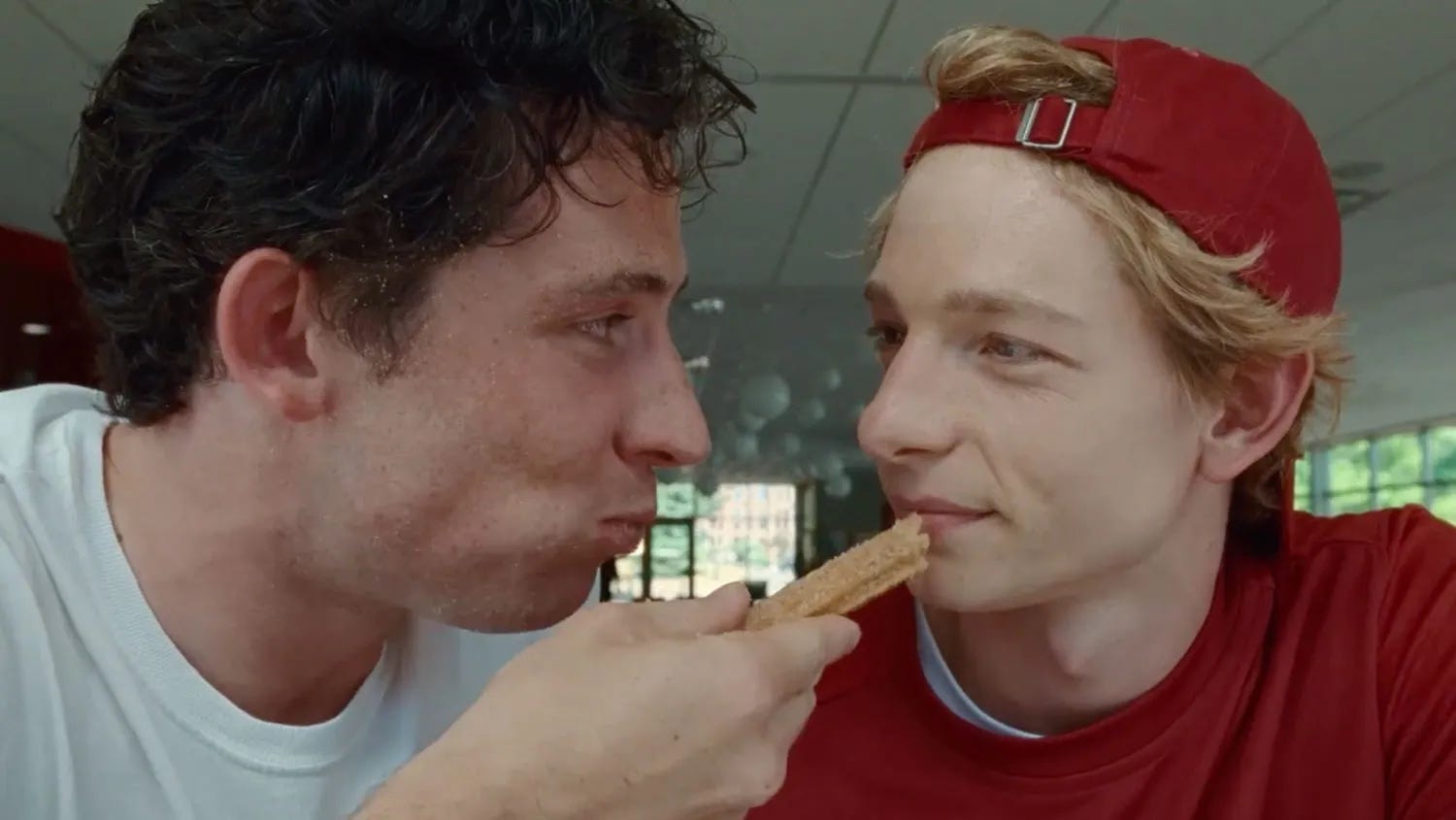
Luca Guadagnino’s Challengers hit screens in April 2024 to wild acclaim. Despite featuring no sex scenes, this story of a tumultuous love triangle between tennis pros has been heralded on social media and in reviews as ‘absurdly’ and ‘extravagantly sexy’. From churros to slow-motion sweat, let’s drill down into what the film has to offer the bi cinema canon.
This essay will contain spoilers. You’ve been warned.
Film Details
Director: Luca Guadagnino
Writer: Justin Kuritzkes
Stars: Zendaya, Josh O’Connor, Mike Faist
Genres: Drama, Sport, Romance
Release Date: April, 2024
Country and Language: USA, English
Running time: 2hrs 11min

Setting the scene
Tashi Duncan (Zendaya) is in a bind. Once one of the most promising young tennis players on the circuit until a career-ending ACL tear, she is now coaching a former Grand Slam-winning player struggling to regain form after an injury. That player, Art Donaldson (Mike Faist), also happens to be her husband. In a bid to improve his confidence, she enters him into an ATP Challenger in New York where he faces off against Patrick Zweig (Josh O’Connor), a talented but less disciplined player who has struggled to make a name for himself in the sport. But this is not their first meeting. As the film jumps between moments from their past to the tense, sweaty sets of the Challenger match, we see how Tashi, Art, Patrick and tennis have been intertwined over the last decade.
“It’s about people wanting what other people don’t want to give. For me, it’s very important to know that, when you want someone, it’s because the other person is somehow, maybe, unconsciously sending back a message.”
Ten years before their tense showdown in the Challenger, Art and Patrick were doubles partners with a deep friendship that stretched back to childhood. Fresh off a win in the junior tournament at Wimbledon, they meet Tashi Duncan, and sparks fly instantly. Between everyone. Tashi controls Art and Patrick’s attention as deftly as she rules the tennis court. They desperately invite her back to their shared hotel room, both anxious to know who she will pick, and the central love triangle of the film ignites.
The moment when the corners touch
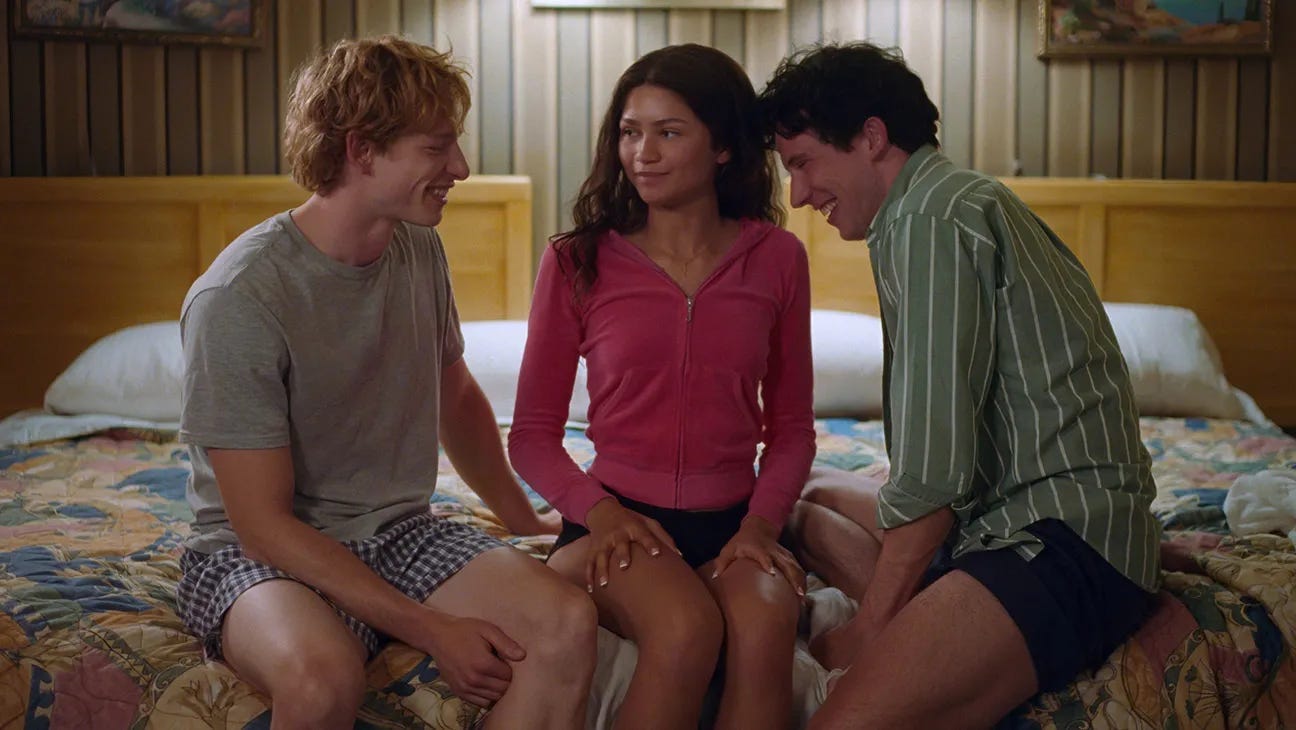
The scene in the hotel room cements the dynamics that will pull the trio towards and away from each other throughout the next ten years. Tashi shows up late, intentionally making Art and Patrick wait and gleefully listening to them scramble to get ready before they open the door. Once inside, she commands the room, persuading them into revealing parts of their relationship with each other. They tell her, sheepishly, that as young pre-teens, they masturbated together on opposite sides of the room while thinking about the same girl (and you could make a pretty strong argument that, symbolically, the main Challenger match is this kind of wank-off too). It’s a truth Patrick is much more comfortable with than Art, and it’s a dynamic Tashi instantly manipulates.
Tashi kisses Art, then Patrick, then beckons them to both kiss her. Eventually they are all kissing each other until Tashi pulls back, and Art and Patrick are passionately kissing each other as she looks on and smirks. Then, as quickly as she pulled them together, she breaks them apart and promises her phone number to whoever wins the singles match between Art and Patrick the next day.
“There is something that’s unlocked once Tashi enters the picture, where the desire is flowing in all directions in ways that are confusing for everybody. To put a name on it or to try to nail it down and say it’s one thing or another runs the risk of flattening it, because the nature of their environment is that they’re all discovering new things within themselves.”
Despite being a central part of the marketing and hype around the film (which we will touch on later), this scene wasn’t an original part of the script. While the love triangle element was always there, a physical manifestation of it hadn’t made early drafts until director Luca Guadagnino requested it be added1:
“Luca felt it was very important that, in any love triangle, all the corners touch.”
It’s hard to imagine a version of the film without this scene, which so clearly establishes Tashi as an object of desire but, in some ways, a proxy for the desire that already exists between Art and Patrick. It also establishes Tashi as unattainable, aloof, and disconnected from a relationship that exists outside of tennis and more attracted to wielding power and control than over either of these men.
“[Tashi’s] always been aware of her power and how to manipulate that over others. Which isn’t really healthy, but she’s always been aware of it. It just used to be just for fun. As she gets older, it becomes a means of survival and getting through life.”
Art, Tashi, and Patrick feed off the energy in this scene for the rest of the film. Art wants to be with Tashi and to forget about Patrick, Patrick wants both Tashi and Art, and Tashi just wants to see some good tennis. The film crackles with this tension despite there being very few instances from this point on where the three characters even touch each other. The rest of the intimacy and desire in the film is communicated almost entirely through tennis.
Touching through tennis
‘If people are saying it is a sexy movie I am happy to hear that. But it’s not because of a lot of sex. I think it’s because of something else.’
Justin Kuritzkes (screenwriter) speaking to Letterboxd, May 2024
Commenters have explained the tennis in the film as a metaphor for sex, but I think it’s a much deeper analogy than that. Before the famed hotel room scene, the teenage versions of the three characters flirt together in the moonlight by the sea as Tashi reflects on her winning tennis match that day:
“It’s a relationship…we understood each other completely. It was like we were in love. Or like we didn’t exist. We went somewhere really beautiful together.’’
Challengers is a great experiment in a more complex depiction of intimacy, representing physical and emotional desire through a sport completely devoid of physical touch. This seems to be a challenge both Guadagnino and screenwriter Justin Kuritzkes set for themselves on the film, wanting to create a movie that spoke through movement, action, gestures, and the physical form on all levels of character dynamics, not just sexual ones2.
Patrick wins Tashi’s number after beating Art in the tennis match. When Art tries to drive a wedge between them, Patrick is more impressed than mad, saying, “It’s exciting to see you this way. It’s what’s been missing from your tennis’’. Tennis becomes the emotional stakes of all their relationships. In the present-day scenes Art questions whether Tashi would still love him if he didn’t beat Patrick, and Tashi asks Patrick to throw the Challenger for Art. Tennis is also how they talk about their past, with Patrick expressing to Art, “I miss playing with you” in a (literally) steamy sauna scene, to which Art replies, “well I don’t miss playing with you man. I’m too old for it”, seeming to reference both the sport and potentially their brief tryst in the hotel room all those years ago.
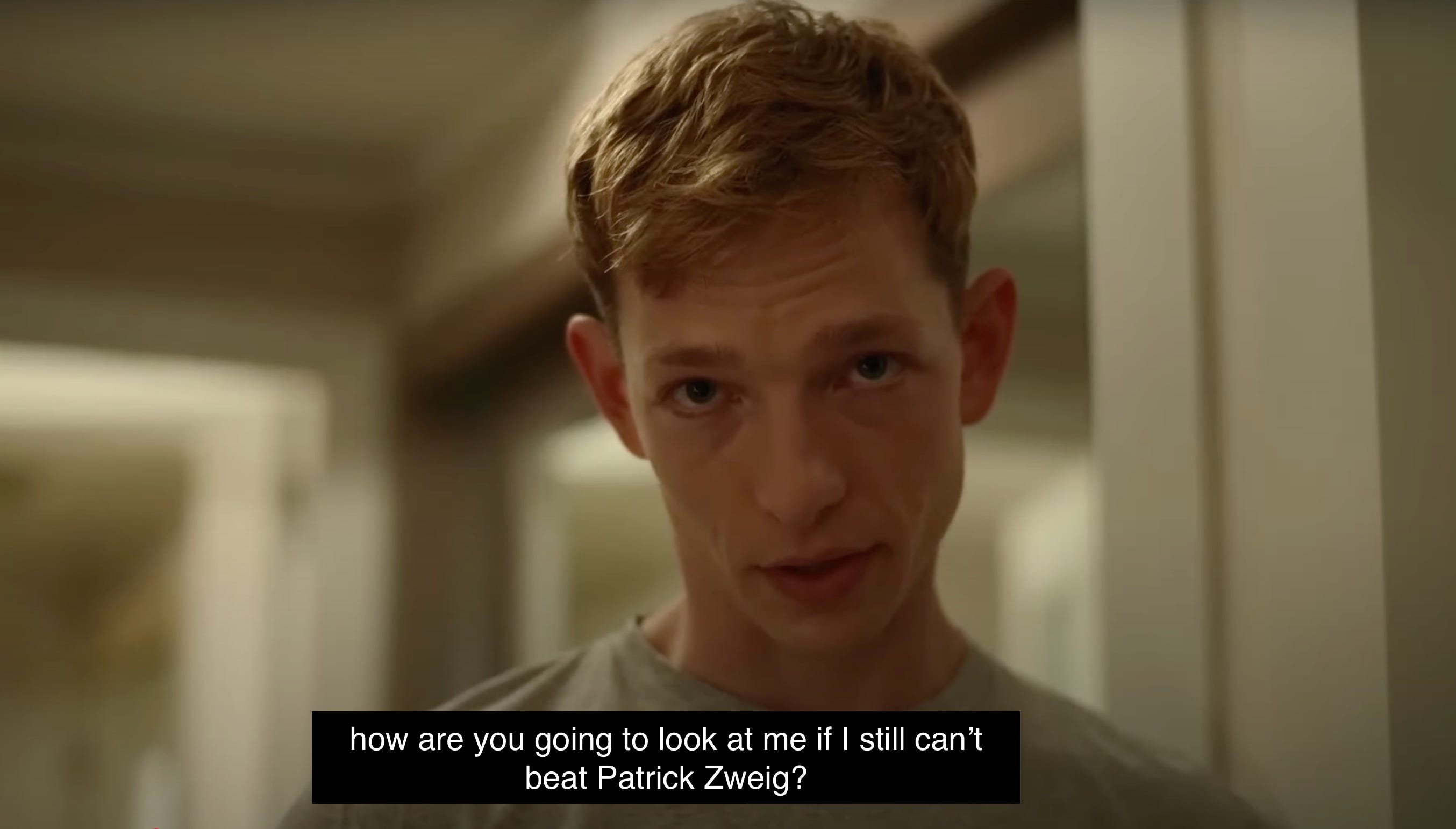
There is a tendency to consider sex a base, driving force desire in humans, but I find it much more interesting to consider desire and intimacy itself as the base, and sex as just one of the many ways to express it. Challengers understands these complexities of intimacy well and resists making tennis a slim, sexual metaphor. Tennis is how the characters communicate, both indirectly through their movements on the court and directly through secret symbols they establish with each other. Tennis is how they argue with each other—from the core Challenger match to Tashi begging Art to push her harder in training after her injury. Tennis is the only way Art and Patrick can be close to Tashi and is what Tashi uses instead of being close to anyone. Tennis is what resolves their interpersonal tension in the final scene, which ends not at the match point of the dramatic tiebreak, but at the point at which they have served and volleyed their way through their conflict and literally into each others’s arms.

What’s bi about it?
There is no doubt that Challengers is a sexually fluid, fun time. From three-way kisses to suggestively phallic foods, it’s a movie that knows it’s hot and is having fun with it. Ultimately, the film isn’t trying to say anything specific about who people should be attracted to or make judgement calls. It’s an honest depiction of the different ways desire and attraction can flow amongst people and the frustrations involved in trying to live that out. However, this approach does lead the film, and its promotion, into some tight corners.
Firstly, there is the marketing of the film. Despite, as we have explored, there being no actual sex scenes, the marketing for Challengers heavily leaned on the sexual element. ExtraTV called the kiss the ‘threesome scene’ in an interview with the cast, and Zendaya discussed the reaction from her family when watching the ‘love scenes’ on Jimmy Kimmel. Both official Warner Bros. UK and Ireland trailers for the film—one set to S&M by Rihanna—show the hotel room scene with clips of the three of them kissing before the shot of Zendaya’s face smirking at something unknown. This leaves viewers to fill in the blanks of what she must be looking at between the two boys, with the expectation being that the full film would show more than what was in the trailers. The reality is, though, the trailer showed almost everything there was to see.
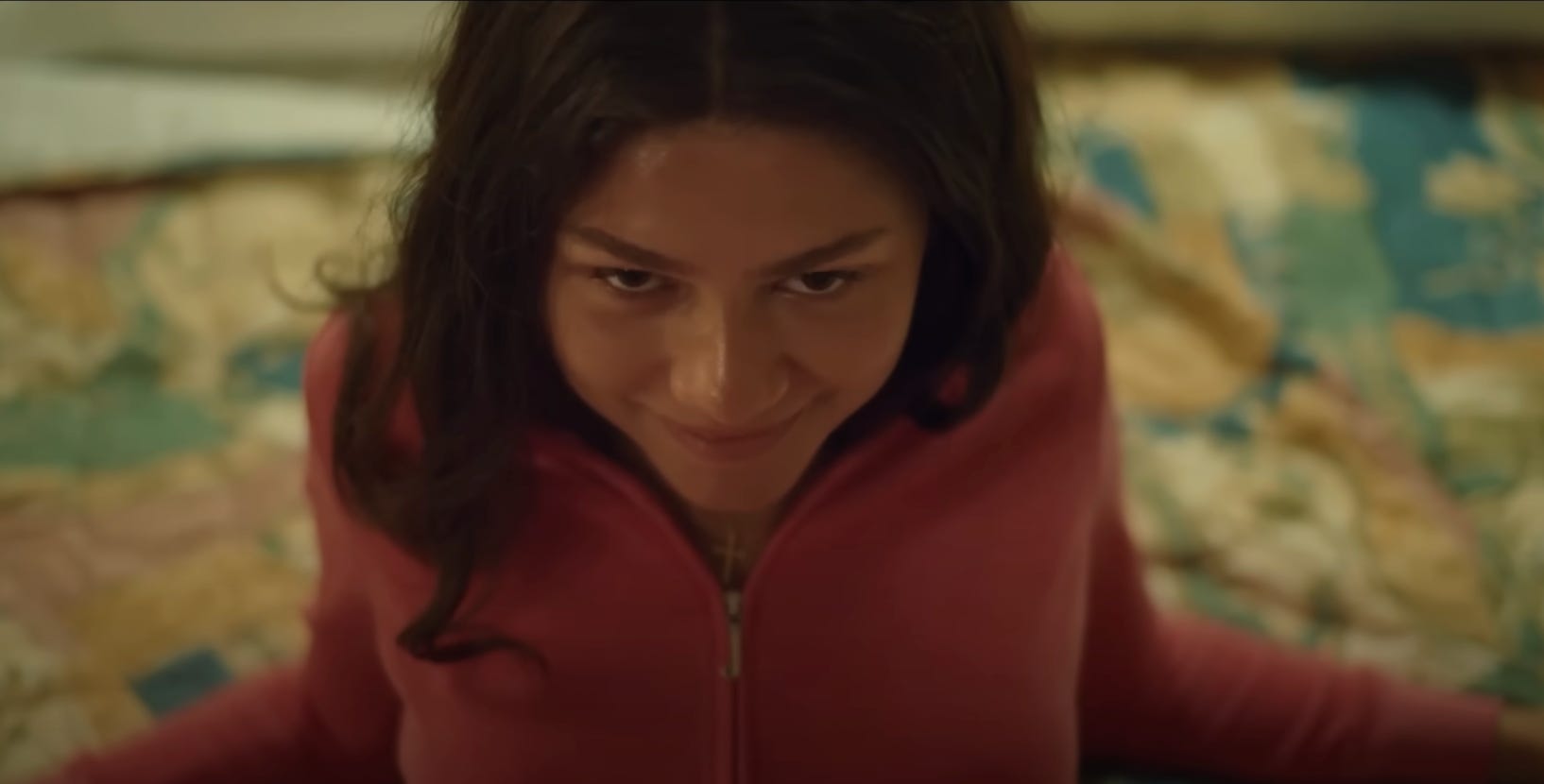
This marketing definitely impacted my first viewing of the film. I went to see Challengers thinking it would be explosively bi, with potentially some polyamory thrown in. Opinions I saw on social media about the film also hyped it up in these terms. This cocktail of lofty expectations left me feeling disappointed and a bit used. In the past, marketing of films with queer content has often involved masking or downplaying queer elements to appeal to a heterosexual audience3. The studios want to make money, and there has long been a perception that gay stuff is not the way to do that. So, momentarily, the marketing of Challengers cashing in on sexual fluidity and a suggestion of non-monogamy felt like something to celebrate. The film offered something sexy and queer, but in a way that was different from what the marketing suggested. What we got was great, but it wasn’t exactly what was promised, and it felt like the marketing fetishised the idea of a certain type of queerness but was repulsed by the reality of it.
Going into my second viewing free from the marketing haze, I appreciated what the filmmakers had to offer me a lot more. That being said, I think when I hear people say Challengers is peak bi cinema, I feel we can aim a little higher. This film is sexy, bold, and a welcome addition to the bi canon, but we can probably dream bigger for ‘peak’ bi cinema than two boys kissing in front of a straight girl.
Things also get a bit thorny around the characterisation of Patrick, the most bi-coded player in the story. Patrick is clearly attracted to Art, and he is also shown swiping through both men and women on Tinder. Kuritzkes has said there is ‘intentional ambiguity’ around Patrick’s sexuality, but there is also an element of deviance, which at times aligns very closely to the ‘depraved bisexual’ trope.
The ‘depraved bisexual’ trope makes up a not insignificant amount of bi representation in media. This stereotype tends to depict bi people as ‘untrustworthy, unfaithful, disloyal, or merely using their sexuality as a means to an end rather than as a real desire or part of their identity’4. Patrick is not only depicted as being these things, charming his way into hotel rooms and conducting an affair with Tashi, but is also discussed within this framing. When asked about Patrick’s Tinder settings in a GQ interview, Kuritzkes responded:
“He needs a place to sleep that night, but also his Tinder settings are set the way they're set. I think the audience should piece that together for themselves and do what they want with it. I don't think Patrick is particularly interested in any of the people he's swiping on.”
To be clear, this does not make the film bad, nor does it make Patrick’s character a hollow stereotype. It is okay for these kinds of depictions to exist, and Patrick’s character fits with this behaviour. Issues with these depictions come when they are the only depictions that exist5. Research from GLAAD shows that this kind of illustration of bi people is still very common in media6, and while it is not the job of one single movie to undo that trend, it’s something to be aware of. If you’re in the mood for the messy bi type (which we all are from time to time), have at it. But if you’re feeling a bit oversaturated with that trope, it’s fine if this doesn’t sit right with you.
We should remember, though, that Patrick is not the only bi-coded character. While it may have only been for a moment, Art was into Patrick as much as he was into Tashi. His feelings here can still be read as bi, whether he continued to feel that attraction for Patrick beyond that moment, felt it for other men, or never felt it again. Where Patrick seems confident in who he is attracted to, Art is never quite able to grapple with it and is at times seemingly embarrassed by what he has felt and experienced. Some may make the argument that he only made out with Patrick because that is what Tashi wanted, but in my view, heterosexual people don’t tend to get that into kissing people of the same gender (no matter how hot the girl they are supposedly doing it for is). Art’s sexuality has not been as much of a topic of discussion as Patrick’s, but this representation is just as important in forging a broad image of what being bi means and allowing people to see their experiences on film.
While the film doesn’t delve into either of these bi-coded representations in detail, I wouldn’t say that is a fault. The movie isn’t about people defining and exploring their sexuality for themselves; it’s about the specific, enclosed desires between three people that don’t have much time to think of anything else but tennis. If you are prepared for that going in, hopefully you will have a fun time.
Final thoughts
Challengers is a good entry point if you want to know what a mainstream queer movie can offer you at the moment. Fans of EDM music, slow motion, and sweaty tennis lads won’t be disappointed either. It doesn’t get everything right (because nothing does), but it’s an indication we are on the right-ish track maybe sometimes. I would be wary of claims that this is the pinnacle of bi cinema (because no one film can be), but it’s a good addition to the Bi Blockbuster shelves we are putting together here. While I do want to see more films being comfortable with saying ‘bi’ or ‘pan’ or similar terminology, I appreciate this film wasn’t about defining what everyone is to each other and what their feelings or actions make them. It’s just about what they want and what they feel, and I like that we are at a point where that doesn’t need to be so heavily questioned. It’s an approach that suited this movie, but I hope isn’t something future films see as a precedent to avoid giving a name to what can be named when it is more necessary.
A huge chuck of the creative team of Challengers also collaborated on the recently released Queer (2024)7. It’s a very different tone and much more arthouse in nature, but if you want to see how this creative relationship explores the work of William S. Burroughs through the star power of Daniel Craig, it’s there for the taking.
Congratulations if you have made it this far. I hope this obnoxiously long essay gives you an idea of whether Challengers is your kind of thing or not (and either position is absolutely fine). See you next month, and tell your friends about me!
Let’s do this together
I would love to get your comments and insights on my work so we can grow this place together. Please like and share and comment and all that other stuff. It’s much appreciated.
You can also follow Trial Bi Media on instagram and Alyssa Marie on letterboxd.
“‘Challengers’ Screenwriter on the ‘Homoerotic’ Nature of Tennis and How Zendaya’s Child Stardom Informs the Film” by Selome Hailu in Variety, 27 Apr. 2024.
“Luca Guadagnino: ‘I Don’t Watch Tennis Matches. It’s Quite Boring to Me’” by Davey Jenkins in Little White Lies, Apr. 2024.
“‘I’m Writing This Because I Want To See This Movie’: Screenwriter Justin Kuritzkes on Writing Challengers” by Jesse Pasternack in Filmmaker Magazine, 24 Apr. 2024
San Filippo, Maria. The B Word: Bisexuality in Contemporary Film and Television. Indiana University Press, 2013.
GLAAD Media Institute. Where We Are on TV 2022-2023. GLAAD Media Institute, 2023,
Shaw, Julia. Bi: The Hidden Culture, History and Science of Bisexuality. Canongate, 2022.
GLAAD Media Institute. Where We Are on TV 2022-2023.
Both Challengers and Queer have the same director (Luca Guadagnino), writer (Justin Kuritzkes), cinematographer (Sayombhu Mukdeeprom), editor (Marco Costa), composer (Trent Reznor) and costume designer (Jonathan Anderson).
This was so thorough and beautifully written, looking forward to seeing what you write about next.
AND i love the name of your blog!
Excellent write up! One of my favourite movies from last year. 🙌