

The Twilight Saga: Eclipse (2010)- A thorough bisexual deconstruction of the tent scene

One of the great rumours of the internet roots the creation of Twilight, 50 Shades of Grey and the downfall of Ellen DeGeneres in 9/11.
The theory proselytises that after witnessing the attack in New York, Gerard Way was inspired to form the band My Chemical Romance. This musical endeavour, in turn, inspired a Mormon woman in her late 20s named Stephenie Meyer to write vampire My Chemical Romance fan fiction (not super far-fetched considering their first album had a disclaimer on the CD that said producing unauthorised copies would ‘result in Gerard coming to your house and sucking your blood’1).
From this, Twilight was birthed. Leading to a hit film series and its own line of fan fiction, one of which turned into 50 Shades of Grey. Dakota Johnson is cast as the lead in the film adaptation, which shoots her into stardom and eventually lands her on The Ellen DeGeneres Show, where she calls Ellen out for ignoring her birthday party invitation.
Some elements hold up to scrutiny2, but if you dig beneath the surface, the key fan fiction strand of the story seems to be apocryphal. And Ellen’s real downfall was more likely related to poor treatment of staff. But it’s this spirit of wild speculation and fan theorisation that I want to bring to this analysis of the third instalment of the Twilight franchise - the 2010 film Eclipse (David Slade). Specifically, a scene of significant bisexual tension involving a tent, a werewolf, a vampire, and a human teenager.
Please indulge me.
Film Details
Director: David Slade
Writer: Melissa Rosenberg (based on the book by Stephenie Meyer)
Stars: Kristen Stewart, Robert Pattinson, Taylor Lautner
Genres: Fantasy, romance
Theatrical Release Date: June 2010 (USA)
Country and Language: USA; English
Running time: 2hrs 4mins
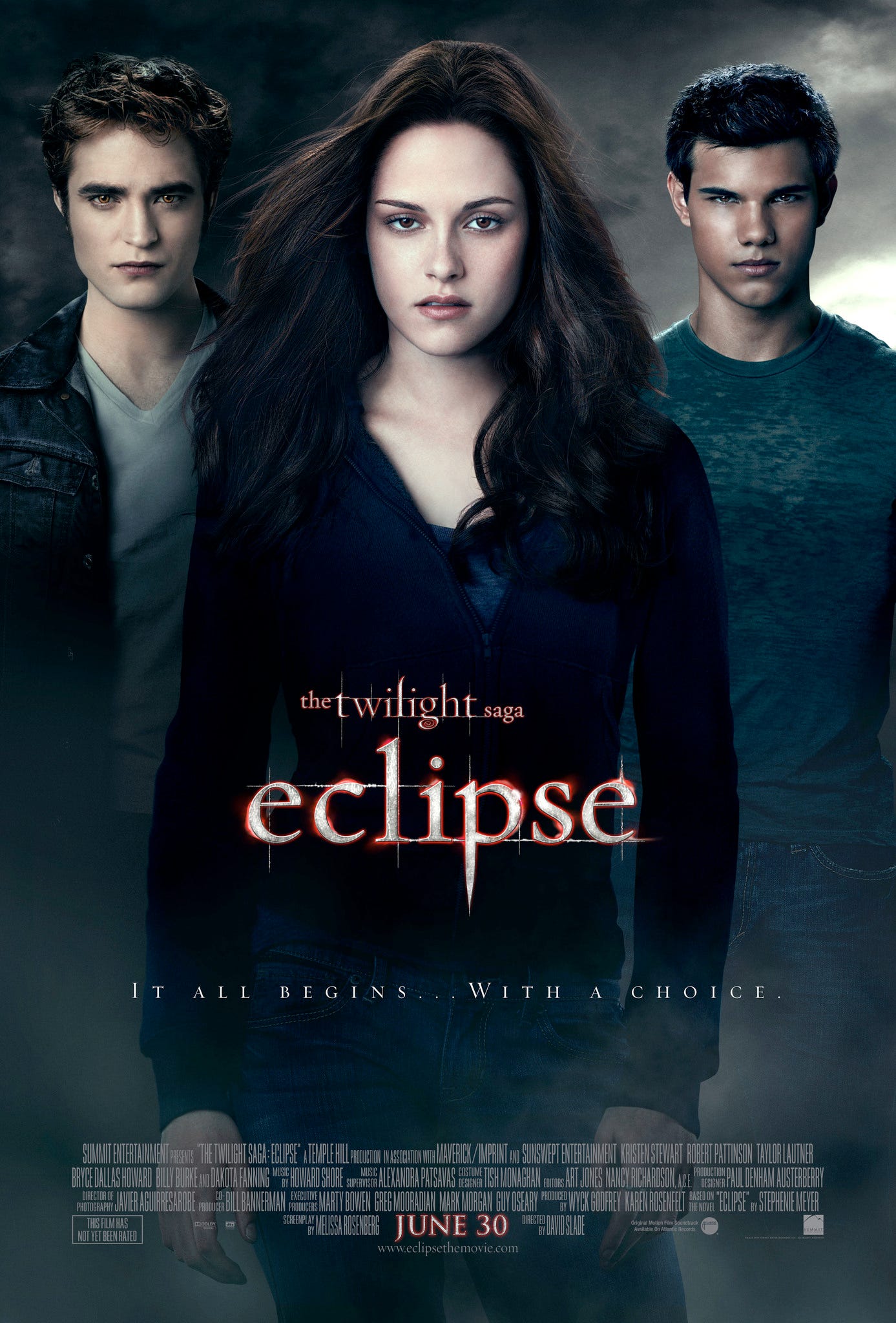
Setting the Scene
“Anyone walking into “Eclipse” without seeing the previous two movies would be genuinely perplexed; behavior that barely makes sense when you know the story becomes truly nutty without context.”
To rapidly condense the Twilight story so far, after moving to the perpetually overcast town of Forks, Washington, our teen protagonist Bella (Kristen Stewart) meets the moody, mysterious Edward Cullen (Robert Pattinson). Bella is enchanted by his ‘no one gets me’ attitude, and Edward is enchanted by the smell of her blood because he is, of course, a vampire (and Bella has special, super good smelling blood. That’s canon). As all teens and 104-year-old vampires trapped in the body of teens do, they fall in love. Then things get complicated.
At the end of Twilight, Bella is attacked by a rogue group of vampires. Edward and his vampire family save her, but Edward fears the risk he poses to Bella by being with her. In New Moon, Edward has left Bella with little warning, and Bella is thrown into a deep depression. Her only light is her friendship with Jacob (Taylor Lautner), forged as the two rebuild a motorcycle together because Bella is cool and not like other girls.
Jacob also has eyes for Bella, his puppy love quite literal because he is, of course, a werewolf. The mortal enemies of vampires. Then things get more complicated.
Bella is constantly putting herself in danger, motivated by a lack of interest in a life without Edward and also hoping that her risky stunts will draw Edward back to her. There is some slight miscommunication that leads Edward to believe that Bella is dead, and he, of course, attempts to take his own life because he can’t live without her in the world.
Thanks to some quick thinking that, of course, involves driving a sports car to Italy, Bella stops Edward, and the two are reunited. But this makes things even more complicated.
By the beginning of Eclipse, Edward is back in Forks, which, of course, creates tension between him and Jacob, who is, of course, still madly in love with Bella, and, of course, there is now a rabid vampire army hell-bent on killing Bella, and, of course, vampires and werewolves must put aside their differences to save this teen and restore peace to the northwest region of Washington state.
Some other things that are worth noting are that Edward can read minds, vampires sparkle in the sun, and there is an evil vampire council sort of running stuff behind the scenes.
At face value, there is absolutely nothing queer about the Twilight franchise. If anything, it’s an aggressively heterosexual and patriarchal text without even a stereotypical gay best friend to be seen. Eclipse in particular is very chaste. Bella’s sexual urges are rebuffed by Edward, who refuses to be intimate with her until they are married. Jacob continually refuses to accept Bella’s shunning of his advances, which is glorified as devotion rather than stalking. Both men glower at each other, professing their undying love for Bella while simultaneously refusing to let her have any agency in her life. Literally. Edward won’t let her drive herself anywhere in this movie, and Jacob insists on carrying her miles through the woods at one point.
And yet, it feels kinda gay.
Particularly when these three hunker down in a tent amidst a snowstorm on the eve of a big vampire-werewolf showdown.
Still with me? Let’s go camping.
The Tent
“This was, from the beginning, for me the most important scene”
Stephenie Meyer in the Eclipse DVD commentary
The wind howls through the night outside the flimsy canvas. Inside, Bella shivers, her fragile human constitution ill-equipped for the freezing temperatures. Edward watches over her, pained and helpless. As a vampire, his freezing cold body cannot alleviate her suffering. Jacob, our lovelorn teen werewolf, brashly enters the tent. It goes without saying that he is shirtless. As insulated against the cold in human form as he is in wolf form, he draws Bella to him. She braces herself against his chest.
[“You look like you’re milking him,” Robert Pattinson says to Kristen Stewart in the DVD commentary of the film at this point.]
“You’ll warm up soon,” Jacob says to Bella before looking Edward dead in the face and adding, “faster if you took your clothes off.”
[“He’s looking at me when he’s saying this stuff,” Pattinson observes in the commentary. “Yeah that’s weird.”]
Bella begins to drift off to sleep in Jacob’s embrace. All the while, Jacob and Edward’s eyes are locked onto each other. With the love of both their lives between them, the two talk about which one she really loves the most, who she will choose, and what that would mean for them both.
[“He’s just so laser focused on Jacob right now- Bromance!” producer Wyck Godfrey says in the commentary.]
At the textual level, this is nothing more than two love rivals facing off against each other. A fantasy scenario not uncommon in romance novels where two men love a woman in an intense, vaguely threatening, heterosexual way. But I am not the only one to have watched this scene and felt that, in a different world, there could have been something else going on. Take it away, Roger Ebert:
“Edward admits that if Jacob were not a werewolf, he would probably like him, and then Jacob admits that if Edward were not a vampire — well, no, no, he couldn’t. Come on, big guy. The two of you are making eye contact. Edward’s been a confirmed bachelor for 109 years. Get in the Brokeback spirit.”
Some fan theories stop there, wishing that this moment of tension had been broken by passion freshly kindled between the two. But allow me, if you will, to take this further. Let me take you to a world where this is not just a single moment but the culmination of Jacob’s internalised bisexual struggle.
My bisexual Twilight theory
First, we must understand another element of Twilight lore - imprinting. This is the process by which werewolves find their soulmates. The process is instant, happening as soon as a werewolf lays eyes on the imprintee. Suddenly they are hopelessly devoted to this person and will do anything to protect them. The Twilight wiki has the specifics of the grooming imprinting process.
1st stage—If the imprintee is young, the shape-shifter will act as an older sibling.
2nd stage—As the imprintee grows older, the shape-shifter will also come to be their best friend.
3rd stage—They become intimate friends, meaning, their feelings for each other are changing into romantic feelings. This stage may or may not happen to the imprintee, but the imprinter will fall in love with his imprintee. They will not “see” any other woman at all. Their imprintee is all he cares about and he will love her even if she rejects him.
4th stage—When the imprintee is old enough, the shape-shifter’s feelings grow into romantic love.
This is relevant because, famously, Jacob ends up imprinting on the baby Bella and Edward have later in the series (yes, I know that raises many questions, but that’s going to have to be something we explore another time).
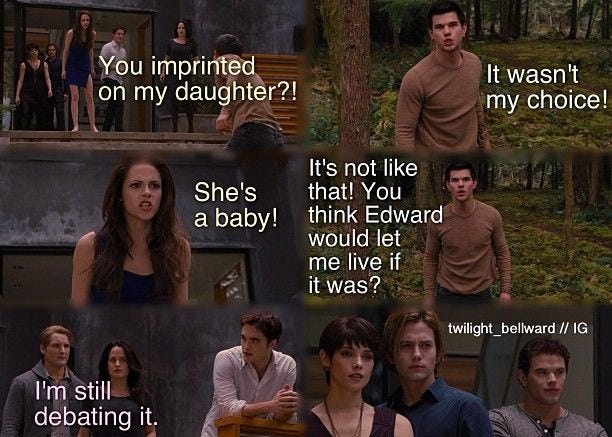
As imprinting is a biological process, it could therefore be reasonably argued that at least some of Jacob’s attraction for Bella relied on the fact that she is the mother of his soulmate. A case of his werewolf brain being fooled by genetics. But Bella is only half of the story. Would it not also stand to reason that Jacob could be partially attracted to his baby-soulmate’s father?
Maybe the anger Jacob has towards Edward is not just because of the innate opposition between vampires and werewolves or the torment he feels over this vampire stealing away the woman he loves. Perhaps he is also confused by his attraction to Edward. An attraction that could be nothing more than unnatural in this world of vampire-werewolf rivalry. An inner turmoil often experienced by queer people discovering their feelings in homophobic environments.
And all the while, Edward’s mind-reading capabilities allow him to know all of this. Perhaps further adding to Jacob’s torment. It’s a queer trope we have seen before in the closeted bullies of Glee, Sex Education and Shameless. Someone from a homophobic background unable to reconcile how they feel internally, expressing this through hatred for those who can see, or who live as, what they truly wish to be.
Now take all that context and throw it into that tent. Jacob’s bravado becomes nothing more than a smokescreen. A thinly veiled attempt at asserting his heterosexuality, all the while knowing Edward can see through him. It gives a whole new meaning to these lines from the tent scene in the original book:
“No one said you had to listen,” Jacob muttered [to Edward], defiant, yet still embarrassed. “Get out of my head.”
“I wish I could. You have no idea how loud your little fantasies are. It’s like you’re shouting them at me.”
Final Thoughts
There is nothing intentionally hidden in Eclipse. Both the movie and the text it is based on have almost no subtextual substance. This is not like Wild Things (John McNaughton, 1998), where years later the creator will reveal those two male characters were in fact supposed to get it on. In a 2013 interview with The Guardian, Meyer was clear that these stories are just her own fantasies, based on nothing but her own experience, and not intended to give any deeper message:
“I never decide to put a message in anything. I decide on a story that I think is exciting, and I entertain myself, and then some of it obviously reflects my personal experience.”
As Pattinson says while watching the tent scene in the commentary, if you read anything between Jacob and Edward at that point, “I think that’s says more about you.”
This is the beauty of the process of queering. Taking a text and choosing to read it outside of the boundaries it was created in. Boundaries which are often heteronormative and sexist. My Eclipse theory has always been just something I throw out at parties when I am just the right level of socially awkward and inebriated, but this process in general does have a much deeper meaning. Before making space for themselves in the real world, many queer people will first make that space for themselves in the movies they see and the books they read.
The Twilight films are a favourite amongst many queer people I know. Whether it’s unintentional camp, the historical association of queerness and vampires, or the attraction many women suddenly realised they had for the character Alice (Ashley Greene), this story has found an alternative home with an audience it was never intentionally made for. It’s a process that Twilight’s own queer-icon star Kristen Stewart has gone through:
“I can only see it now…I don’t think it necessarily started off that way, but I also think that the fact that I was there at all, it was percolating. It’s such a gay movie. I mean, Jesus Christ, Taylor [Lautner] and Rob and me, and it’s so hidden and not OK. I mean, a Mormon woman wrote this book. It’s all about oppression, about wanting what’s going to destroy you. That’s a very Gothic, gay inclination that I love.”3
My Eclipse queering is just one of many, and one I will hold dear to me no matter how many intense Reddit treads I read that suggest my view of werewolf grooming imprinting is not accurate to the mythology.
I am proud to stand with those that see more to Eclipse than meets the eye. K Stew, Roger Ebert and the authors of 664 separate Jacob/Edward fan fiction pieces on AO3 are honourable company.
Love to make up your own alternative gay plot lines in hetero movies? You might like my post on the concept of Queering.
Let’s do this together
I would love to get your comments and insights on my work so we can grow this place together. Please like and share and comment and all that other stuff. It’s much appreciated.
You can also follow Trial Bi Media on instagram and Alyssa Marie on letterboxd.
Source: I owned this CD as a teen. When I read that as a raging Twilight fan at age 13, oh how I giggled
Way did found My Chemical Romance following 9/11. And 50 Shades of Grey did start out as Twilight fiction. Stephenie Meyer has cited My Chemical Romance as an influence for Twilight, but evidence that it had fan fiction origins is scant.
Quoted in Adam B. Vary “How Kristen Stewart Became a Queer Trailblazer.” Variety, 11 Jan. 2024.